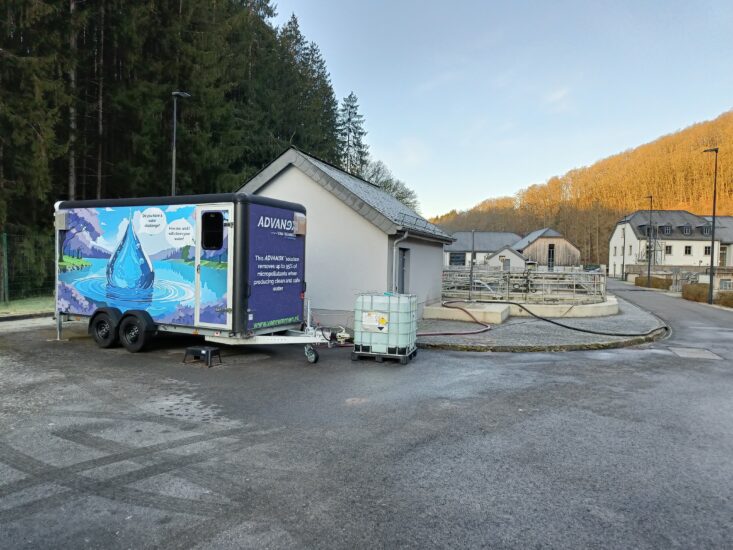
The Heiderscheidergrund wastewater treatment plant in the North of Luxembourg discharges water into the river named “Sûre” which is extensively used, as is the whole catchment area including the “Haute-Sûre”-Lake, for touristic purposes during the summer months. To keep the water as safe as possible, they are tackling the issue of pharmaceutical residues. And Advanox Flex offers promising results in this regard.
Pharmaceutical residues: a growing challenge
When the summer months arrive, thousands of tourists flock to Luxembourg’s beautiful hilly landscape. But while they are enjoying a refreshing dip in one of the many rivers, the engineers at the local wastewater treatment plant work tirelessly to keep the riverswithin the catchment area free of a growing number of pharmaceutical residues. “The Heiderscheidergrund wastewater treatment plant treats water from municipalities in the region and discharges it into the “Sûre”,” says Thomas van Remmen. “That water must be as clean as possible. With the new (strict) European guidelines on the horizon, this applies not only during the summer months, but all year round.”
What is the right treatment method?
The local water management organisation Syndicat Intercommunal de Dépollution des Eaux résiduaires du Nord (SIDEN) joined forces with the Administration de la Gestion de l’Eau (water authority) University of Luxembourg, the German engineering firm Wupperverband and Van Remmen UV Technology for an international demonstration. ‘’ We are using the Advanox Flex system, a mobile advanced oxidation system that is ready for direct use’’ explains Thomas van Remmen. ‘’The wastewater from the WWTP is treated as an additional step with a combination of hydrogen peroxide and UV-C light. This is highly effective against tough contaminants such as pharmaceutical residues.’’
The test in practice
The pilot installation treated approximately 10 cubic metres per hour. Thomas: ‘’After conventional biological treatment, the water passed through the Advanox system and then returned to the treatment plant. We monitored the water quality for six months, under a variety of conditions.’’ Water samples were taken every two weeks to measure 12 European indicator substances. They also tested different UV doses and hydrogen peroxide concentrations.‘’ We wanted to know: what is the optimum balance between cost and result? Is that achieved with higher UV dose or with more hydrogen peroxide?’’ The conditions were favourable. ‘’Transmittance was between 70 and 80%, which is relatively high for wastewater. That makes UV treatment more efficient. But there was also a challenge: a relatively large amount of dirt accumulated on the quartz tubes. You could see that in the results. However, after establishing a good cleaning schedule, the system ran stable for two months. Regardless of the water conditions.
The results
The new European directive requires a minimum of 80% removal of pharmaceutical residues. Advanox consistently achieved this during this demonstration, and often well above the requirement removal. With the correct settings, the removal rate was between 85% and 95%.
But perhaps even more interestingly: Advanox also proved to be a buffer against fluctuations in the performance of the biological treatment process. Thomas: ‘’on one measurement day, the biological treatment achieved only 20% removal of pharmaceutical residues. Advanox increased that to 90%. On another measurement day, the biological treatment achieved almost no removal (perhaps due to temperature or a measurement error), but because Advanox was there to back it up, the end result remained above 80%.’’ That stability makes the system valuable, particularly in the context of seasonal influences such as fluctuating temperatures or increased tourist numbers (and consequently more pharmaceutical residues in the sewage) during the summer. In addition, disinfection has also been demonstrated, making the current UV installation redundant in the summer period.